
Uploading a logo file takes about ten seconds. Turning that logo into a sign, though, takes days of designing, cutting, bending, soldering, and testing, most of it out of sight. For a shop owner counting down to opening day, that hidden process is the nerve-wracking part. Will the brand colors hold up once they're made of light? Can a thin script still be read from the sidewalk? Then there's the box, which has to survive the trip.
How are custom neon signs made? We develop a free digital mockup of your idea or logo. We don’t build anything until you approve it. We then laser-cut the acrylic backing, hand-shape the LED neon flex to your design, solder and wire each section, test, and pack. Here at Neon Designs, we usually ship orders within 14 business days after approval, including production and shipping.
Seeing each step makes ordering custom neon signs feel much more straightforward. Here’s a breakdown of each stage in order, and what to look for before you approve a design. What changes when a sign is going outdoors?
Custom Neon Sign Process and Timeline
Every sign moves through seven stages, and a two-word café sign follows the same path as a multi-color gym wall logo. Nearly all of your part happens at the start. That's the right place for it, because changing a mockup takes a few clicks, while changing a finished sign means rebuilding it.

| Stage | What happens | Your part |
|---|---|---|
| 1. Share your idea | You send text, a sketch or a logo file | Add the size, location and any deadline |
| 2. Free mockup | A designer redraws it as a neon layout with real colors and dimensions | Review it and ask for changes |
| 3. Approve and pay | A sign specialist sends the mockup with a product page and price | Approve the design and check out |
| 4. Build | The backing is laser-cut, then the LED flex is hand-formed, soldered and wired | None, the build team takes over |
| 5. Test | Brightness, color accuracy and every connection are checked | None |
| 6. Pack and ship | Foam-lined packing, Fragile labels, DHL or UPS with tracking | Watch for the tracking email |
| 7. Install | Mounting kit, dimmer remote and power adapter arrive in the box | Hang it and plug it in |
Your mockup usually lands within 12 hours of the request. Production starts once you approve it and pay. Up against an opening day or an event? A 7-business-day expedited turnaround is available for $80. More involved builds (multi-color logos, oversized signs, or UV-printed elements) can add a couple of days, and you'll get the exact timeline before you commit.
What You Need to Order a Custom Neon Sign
You need less than you might expect. Send the words or artwork you want lit, a rough size and where the sign will hang, and a designer can take it from there.
-
Your text or artwork. Logo files in AI, PNG, SVG, or PDF all work. Vector formats (AI, SVG, or PDF) give the cleanest starting point, though a clear photo of a sketch or an old sign is enough to begin.
-
A rough size. Measure the wall or window space instead of guessing in inches. The 20 to 40 inch range covers most orders, including business logos and retail displays.
-
Where it will hang: indoor or outdoor use changes the build, and a window placement changes how the sign has to read from the street.
-
Your brand colors. Share your color codes so the designer can pick the closest LED shades.
-
Your deadline. Mention an opening day or event date up front, and production can be planned around it.
A napkin sketch works fine. A 40-page brand book also works, though the designer only needs about two pages.
Short text signs (names, quotes, a few words) can be set up in the neon sign customizer. Send logos, open signs, and artwork to the design team through the Create Your Neon Sign page. If your logo has fine detail, our guide to designing a logo neon sign covers what translates well. Prefer a head start? Browse ready-made designs first.
How Your Idea or Logo Becomes a Neon Sign Mockup
A designer redraws your artwork as lines that LED neon flex can physically follow, then places them on a backing with your chosen colors and real dimensions. That redraw is where much of the craft in a custom sign happens, and it's the step generic guides tend to skip.

A printed logo and a neon logo play by different rules. Print can carry hairline strokes, tiny text, and soft gradients. A neon line has a fixed thickness, and LED flex can only curve so tightly. The designer decides which parts become lit lines, which get pared back, and which move to the backing.
-
Spacing. Strokes need room between them, or the glow blurs neighboring lines together at night.
-
Fonts. Bold block lettering bends cleanly. Thin script needs more precision, which is one reason it costs a little more (our breakdown of what drives neon sign pricing goes deeper).
-
Color. We match your brand colors to the closest of 18+ LED options. Multi-color signs need extra wiring and controllers, and RGB signs (the color-changing kind) sit a step above that.
-
Fine detail. Gradients, small icons, and photo-like elements that tubing can't reproduce are added with UV printing directly on the acrylic backing.
A sign specialist then sends the finished mockup with a product page showing your price and sign details. It's also why an AI-generated neon sign mockup can mislead you. Software will happily draw a curve no human hand could ever bend.
Neon Sign Mockup Approval Checklist
Check the size, lit parts, colors, and backing before you approve. The mockup is the plan the build follows, so what you approve is what gets made.
-
Overall size. Hold a tape measure against the wall at the listed width, because a screen preview makes scale hard to judge.
-
Lit and unlit parts. Confirm which words or shapes glow and which are printed or left plain. Small text like "LLC" or a tagline is easy to miss here.
-
Each color. Screens can't show LED light exactly, so ask how each shade will look switched on next to your brand color.
-
Letter height and spacing. Picture how far away your customers will read the sign from, then check that every word holds up.
-
Backing style. A rectangle, a cut-to-shape outline, or cut-to-letter acrylic changes the look and the mounting. Our acrylic backing guide compares all three.
-
Power cord route. Note where the cord leaves the sign relative to your nearest outlet. The cord runs about 2.8 meters (roughly 9 feet).
-
Indoor or outdoor build. Signs headed outside need the weatherproof version, which is built differently (more on that below).
-
Spelling. Read every word slowly, out loud, twice.
Ask for changes before you approve. Designers adjust the mockup and send a new version back, and a second look now beats a remake later.
How LED Neon Signs Are Built by Hand
Yes, custom LED neon signs are handmade. A machine cuts the backing, but we shape and wire the lit lines by hand once you approve the mockup.

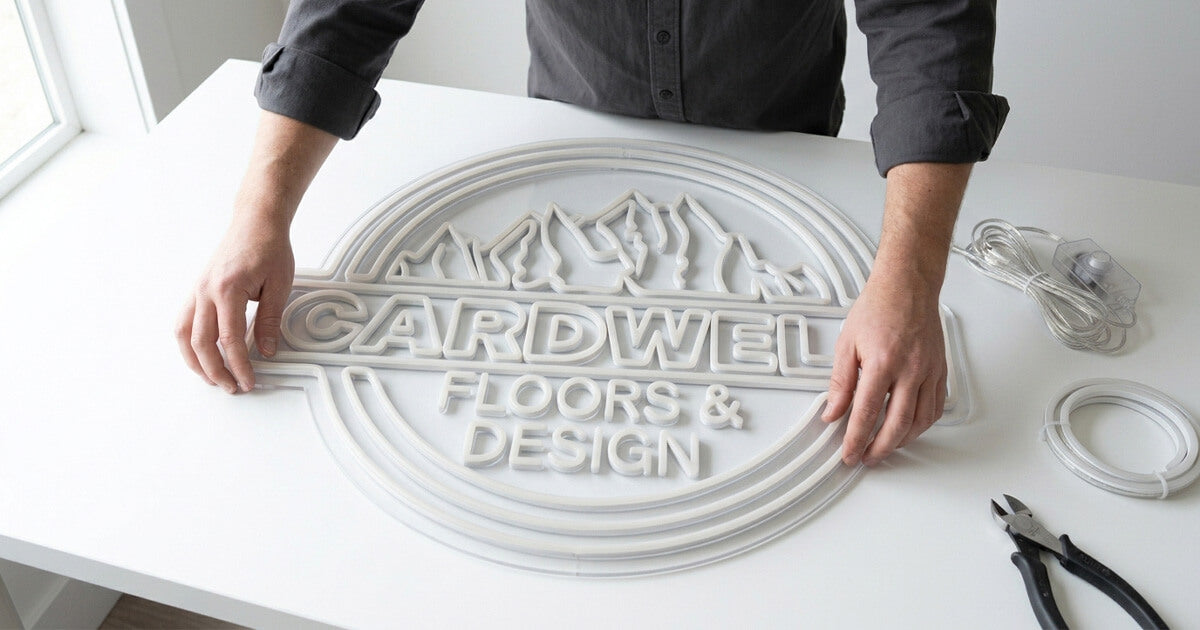
1. The backing is laser-cut. We cut clear acrylic to the approved outline (a rectangle, the design shape, or the edge of each letter) and drill mounting holes.
2. The LED flex is hand-formed. LED neon flex is a run of small LEDs inside a flexible PVC or silicone sleeve that spreads the light into one smooth line. Builders measure each section against the approved layout and bend it along the curves of your design.
3. Each section is soldered and wired. Separate words, letters, and colors are cut as their own runs, soldered to connecting wires, and routed to the power lead. Multi-color and RGB signs get extra connections for their controllers.
4. The flex is secured to the backing. Each run is fixed to the acrylic along the layout, so the sign keeps its shape on the wall.
5. Machines are great at straight cuts. Curves that look effortless on a wall took steady hands and a lot of patience.
This is also where the mockup's limits come from. LED flex has a minimum bend radius, so sharp corners and tiny letters get reworked at the design stage instead of being forced here. For a closer look at each part, see what your LED neon sign is made of.
Indoor vs Outdoor Neon Signs: How the Build Differs
Outdoor signs use a sealed, fully enclosed acrylic build rated IP67, while indoor signs mount the LED flex on an open acrylic backing. That one difference changes the materials and the wiring. It also decides where the sign can safely hang.

| Feature | Indoor sign | Outdoor sign |
|---|---|---|
| Construction | LED flex mounted on an acrylic backing | Sealed, fully enclosed acrylic |
| Tubing | Bendable PVC or silicone | UV-resistant tubing |
| Wiring | Built for dry indoor spaces | Reinforced for moisture and temperature swings |
| Water protection | None, keep it dry | IP67 rated |
| Best for | Walls, windows, offices, bars | Storefront exteriors, patios, rooftop bars |
| Warranty | 2 years | 2 years |
IP67 is a rating under the IEC 60529 standard. The 6 means the sign is dust-tight, and the 7 means it survives immersion in water up to 1 meter deep for 30 minutes. Hanging an indoor sign in a damp spot can quickly void its warranty, because indoor signs used outdoors or in wet areas aren't covered.
Planning a sign for the front of your building? Read our guide to weatherproof outdoor neon signs, then check whether your city requires an illuminated storefront sign permit before you order.
How Each Neon Sign Is Tested Before It Ships
We switch on every sign and quality-check it before it goes near the packaging, because a sign that flickers in the box is far easier to fix than one that flickers above your register. The checks cover three things.

-
Brightness. Each section should glow evenly, with no dim patches or dark spots along the line.
-
Color accuracy. We compare colors against your approved mockup, so the blue you signed off on is the blue you get.
-
Connections. We check every solder joint and wire, since a loose connection is a common cause of flicker.
The electronic components (including the power adapter) are UL certified and CE, FCC, and RoHS compliant. Certified components aren't the same thing as a UL Listed sign, and our guide to neon sign certifications explains what each mark actually covers.
How Your Neon Sign Is Packed for Safe Delivery
We wrap signs in foam padding and bubble wrap, pack them in a reinforced, foam-lined box, and label them Fragile on every side. Shipping is free and tracked through DHL or UPS, and we email you a tracking number as soon as your sign ships.

Inside the box you'll find:
-
Your sign on its acrylic backing
-
A wall-mounting kit (the backing comes with pre-drilled holes)
-
A hanging kit for ceiling or suspended display
-
A dimmer remote with 10 brightness settings
-
A power adapter with a standard US 120V plug
-
Setup instructions
If a box does arrive damaged, photograph the sign and the packaging right away and email the photos, since shipments are covered for loss or damage in transit. Our shipping and handling guide covers timelines and tracking in detail, and the unboxing guide shows what's in the box and how to set it up.
One Barbershop's Neon Sign, From First Mockup to Delivery
Clipperz Barbershop and Beauty shows how these stages play out in a real order. The shop's team didn't land on the final design in one pass, and that's normal.

-
Several mockup rounds. The team kept asking for adjustments, and each round came back quickly as a new concept design.
-
One shared approval. Production started once everyone on the team agreed on the final version.
-
Build and delivery. The shop made and delivered the finished sign within two weeks of that approval.
In their review, the shop credited that back-and-forth with making sure "every detail was perfect."
Two lessons carry over to any order. Spend your energy on the mockup, because that's where the sign gets decided. And bring everyone who has a say into the review early, because one late opinion means another round. For more ideas on shop signage, see how cafés, bars and other local businesses use neon signs to pull in foot traffic.
LED Neon Sign Myths vs Facts
LED neon copies the glow of glass neon, but it has no neon gas inside. That mix-up is the first of several myths buyers bring to their first order.

| Myth | Fact |
|---|---|
| LED neon signs are filled with neon gas | They use small LEDs inside bendable PVC or silicone tubing. Neon and argon gas belong to traditional glass tubes, which need transformers that step power up to roughly 2,000 to 15,000 volts. |
| Custom means waiting months | The typical order is delivered within 14 business days of mockup approval, and a 7 business day expedited option is available. |
| Any logo can be traced line for line | Hairline strokes and gradients don't bend well, so designers simplify them or UV-print those parts on the backing. |
| The mockup is only a sales picture | It's the plan the build follows. The size, colors and lit parts you approve are what get made. |
| Script fonts cost the same as block letters | Thin script takes more precision to bend, so it tends to cost a little more than bold block lettering. |
Glass neon still has its fans. It just doesn't live inside your LED sign. To learn how the glow works, see how LED neon signs work.
Start Your Custom Neon Sign With a Free Mockup
The quality of a custom sign is mostly settled before anyone bends a line of LED flex. The mockup locks in size and color and decides which parts glow. The build turns that plan into light, and testing and packing make sure it reaches you the way you approved it.
 Put your effort where it counts. Check the size against your real wall and confirm which parts light up. Got a deadline? Say so when you send your idea. Once you approve, we typically deliver the sign within 14 business days (7 with the $80 expedited option).
Have an idea, a logo, or a rough sketch? Request your free mockup, and you'll usually have a design to review within 12 hours. When the box arrives, our neon sign installation guide covers mounting it on a wall or hanging it from a ceiling.


Share: