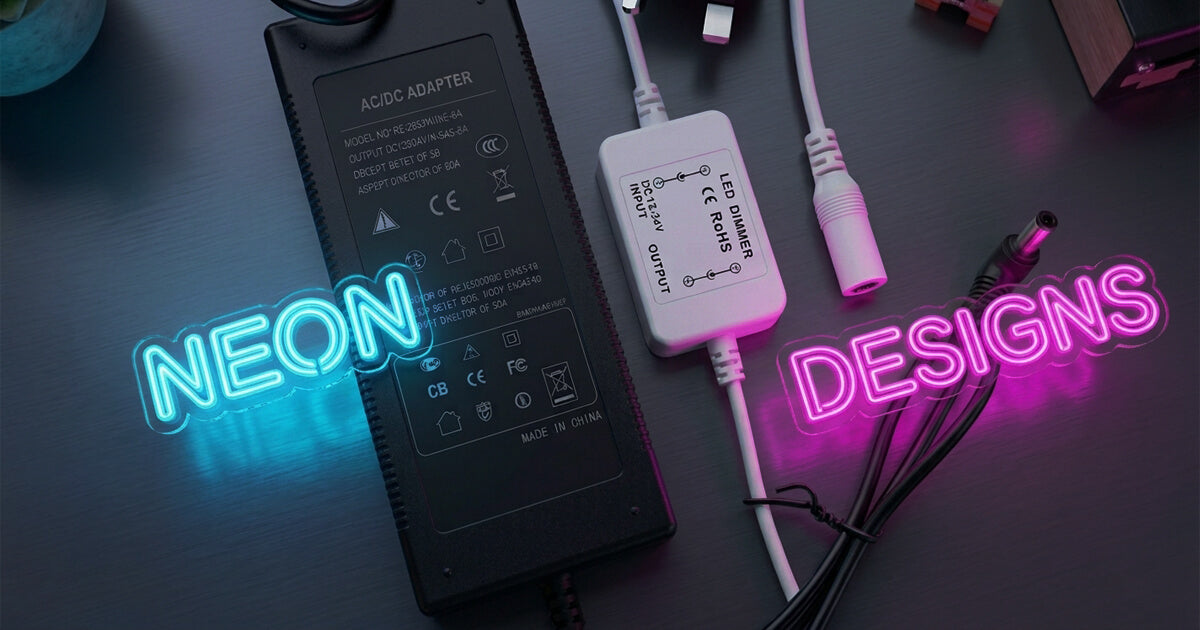

Flip over a plug-in LED neon sign, and you'll usually find four or five small marks printed on the power adapter. Most buyers read them as one blur of reassurance. They aren't. Two of those marks describe electrical safety in the United States, one describes permission to sell in Europe, and one describes what the solder and plastics are made of. They answer different questions, and only some of them mean anything to an American electrician or a building inspector.
That gap causes real headaches. A cafe owner orders signage for a storefront, the fit-out contractor asks for listing paperwork, and what comes back is a phone photo of a CE logo. A parent reads a California Proposition 65 warning on a cord and assumes the cord is dangerous enough to return it. Neither situation needs to happen.
What follows is a plain reading of every mark you're likely to encounter on an LED neon sign sold in the US, which ones an inspector will accept, and how to verify a seller's claim before your card gets charged. Some of it will make certain suppliers uncomfortable. That's rather the point.
What Certification Marks on a Neon Sign Actually Certify
Every mark on a sign answers one of three questions, and confusing them is where most buyers go wrong.
Electrical safety. Has an independent laboratory tested this product against a published safety standard for fire and shock hazards? In the US, that means a listing from Underwriters Laboratories, Intertek, or another lab recognized for the job. This is the category inspectors and insurers care about.
Market access. Does this product have permission to be sold in a particular region? The CE mark falls here. It signals conformity with European Union health, safety, and environmental requirements for products placed on the market in the European Economic Area. It says nothing about American requirements.
Material content. What restricted substances are inside the product? RoHS lives in this category. It limits specific materials in electrical equipment and has no bearing on whether the wiring will overheat.
A sign can carry a CE mark and a RoHS declaration while never having been assessed against a single US electrical safety standard. That combination is common on decorative lighting, and it doesn't make the sign a fraud. What it means is that the marks you're reading aren't the ones answering your question.
| Mark | What it certifies | Weight in the US |
|---|---|---|
| UL Listed | Electrical safety, tested by Underwriters Laboratories | Accepted by inspectors and AHJs |
| ETL Listed | Electrical safety, tested by Intertek | Accepted by inspectors and AHJs |
| CE | Conformity with EU requirements | None, informational only |
| RoHS | Restricted hazardous substances | Environmental, not safety |
| FCC | Radio interference limits | Required, but unrelated to fire risk |
| Prop 65 | California chemical disclosure | A warning, not a defect finding |
Why Built With UL Parts Does Not Mean UL Listed
This distinction costs people permits, so it's worth getting precise about.
Underwriters Laboratories publishes separate standards for finished signs and for the parts that go into them. UL 48 is the standard for electric signs, covering finished products such as signs, outline lighting, and neon tubing. Underneath it sits a family of component standards: UL 879 for sign components, UL 879A for LED sign retrofit kits, UL 8750 for LED lighting equipment, and UL 2161 for neon transformers and power supplies. A sign built entirely from certified components is not automatically a listed sign, because listing the finished assembly is a separate evaluation of both the product and the shop that builds it.
The three claims, ranked by what they prove
UL Listed. The complete product was evaluated, and the manufacturer stays subject to ongoing follow-up inspection. UL's product category for signs (UYXT) covers electric signs that use LEDs, neon tubing, and similar light sources, built for installation under Article 600 of the National Electrical Code.
UL Recognized Component. A part was evaluated for use inside somebody else's finished product. The Recognized mark differs from the Listed mark and was never intended as a consumer-facing certification.
Built with UL components. A description of the bill of materials, carrying no independent verification of the finished sign at all.
Now the practical reality for decorative neon. On most plug-in signs, the mark is on the power adapter rather than the sign itself. That's a legitimate and useful thing, since the adapter is where the mains voltage lives. But it isn't the same claim as a listed sign, and a contractor asking for UL 48 documentation will spot the difference in about four seconds.
Is ETL as Good as UL for a Neon Sign
Short version: Yes. Longer version: the question is aimed slightly off target.
The Occupational Safety and Health Administration runs a program that recognizes independent testing laboratories, known as Nationally Recognized Testing Laboratories.
Underwriters Laboratories is one. Intertek, whose mark reads ETL, is another, recognized since 1989. Several more exist. Because every NRTL has met the same requirements for recognition, OSHA treats labs recognized under the same product safety standard as equivalent in their ability to certify to that standard. Intertek tests to UL standards, among others, then applies its own mark.
So what an inspector checks is whether the sign carries a listing from a recognized laboratory, not whose logo appears on the label. The brand recognition gap between the two marks is a marketing artifact rather than a safety one, and the ETL mark is accepted at every major North American retailer.
Where ETL does get a raised eyebrow is on very cheap imported goods, because a counterfeit mark is a counterfeit mark regardless of which lab it imitates. That's a verification problem, not an ETL problem, and the section below on checking file numbers handles it.
What NEC Article 600 Requires From an Electric Sign
Almost every conversation about certification in American signage traces back to one document, and most neon articles never mention it.
The National Electrical Code, published by the NFPA, governs electrical installations across the US. Article 600 specifically covers electric signs and outline lighting. Section 600.3 requires electric signs, section signs, and outline lighting to be listed and installed in conformance with that listing, unless otherwise approved by special permission. Section 600.4 sets marking requirements, and those labels must be permanent, durable, and weatherproof where the sign is installed in a wet location.
There are carve-outs. Field-installed skeleton tubing and outline lighting don't require listing if they're wired in accordance with the methods in Chapter 3. Enforcement also sits with your local authority having jurisdiction, which is the plain-English reason two towns twenty miles apart can treat an identical sign differently.
Where the code stops applying to you
The code governs installations. A hardwired storefront sign, a channel letter run, and a permanently mounted display all fall squarely inside it, and your permit will reflect that. If you're still weighing formats at this stage, our breakdown of neon signs, lightboxes, and channel letters covers how each one performs in terms of cost and daytime visibility.
A plug-in sign hanging in a bedroom or above a home bar is a different animal. Nobody inspects it, no permit exists, and Article 600 isn't going to knock on your door. The stakes shift from code compliance to plain fire risk and to whether an insurer asks awkward questions if something goes wrong. Both matter. But they aren't under the same pressure, and any supplier telling a home buyer they need a permit for a bedroom sign is selling anxiety.
Projects on the commercial side of that line warrant a conversation with your installer before submitting the permit application. If you're having something made for a storefront, raise the listing question during the custom neon sign brief rather than after the artwork is approved, since specification changes get expensive once fabrication starts.
What CE, RoHS, FCC and Prop 65 Labels Mean on a Neon Sign
These four show up constantly and get misread constantly. Taken one at a time:
CE. The mark declares conformity with European Union requirements covering electrical safety, electromagnetic compatibility, and material restrictions for products sold in the European Economic Area. For products subject to the Low Voltage Directive, the European Commission makes it clear that no notified body is required and that the manufacturer alone is responsible for the conformity assessment. That self-declaration model is a meaningful difference from a UL or ETL listing, in which an outside laboratory conducts the testing. A US building inspector has no authority to accept a CE mark and no reason to do so.
RoHS. The Restriction of Hazardous Substances directive now limits ten substances in electrical equipment. The original six are lead, mercury, cadmium, hexavalent chromium, and the brominated flame retardants PBB and PBDE. Four phthalates (DEHP, BBP, DBP and DIBP) were added under Directive 2015/863. The threshold is 0.1% by weight in any homogeneous material, dropping to 0.01% for cadmium, so a RoHS-compliant sign is low-lead rather than lead-free. It's a materials standard. It tells you nothing about whether the driver runs hot.
FCC. LED drivers are switching power supplies, which makes them unintentional radiators of radio frequency energy. Part 15 of the FCC rules caps that interference. The mark on your adapter is about avoiding disruption to your neighbor's radio.
Prop 65. California requires businesses to warn about exposure to listed chemicals, and cord and wiring insulation frequently triggers it. The warning is a disclosure requirement, not a finding that a product is defective. You'll see identical labels on Christmas lights, extension leads and power tools from every major brand.
What Makes One LED Neon Sign Safer Than Another
Two signs can look identical in a product photo and behave very differently after eight months on a wall. The differences sit in components buyers rarely think to ask about.
The power supply. A sign that runs 12 hours a day in a restaurant puts a sustained thermal load on that supply, and we've covered in more detail what that means for signs left on overnight.
Strain relief. Look at where the cable enters the sign and where it meets the adapter. A molded, properly anchored entry point resists the tugging that eventually breaks conductors inside cheaper assemblies.
Ingress protection. IP ratings describe resistance to dust and moisture. An indoor sign near a bathroom, a kitchen splash zone, or a covered patio needs a rating that matches the environment, and anything sold without a stated rating should be treated as strictly dry-location. Our weatherproof neon sign guide explains which ratings actually hold up outdoors.
Tubing material. Silicone handles temperature swings and flexing better than PVC, which stiffens and yellows over time. On day one, the visual difference is negligible. At the two-year mark, it's obvious.
Backing and mounting. Pre-drilled acrylic with proper standoffs distributes load. Thin backing with a single hanging point is how signs end up on the floor.
None of those five appear on any certification label, which is exactly why a listing is a floor rather than a ceiling. Certification indicates that a product met a safety standard. Build quality tells you how it will age.
How to Check If a Neon Sign Is Really Certified
Claims are cheap. Verification takes a few minutes and separates real documentation from a logo somebody pasted into a product image.
Ask which component the listing covers. The single most useful question you can ask a supplier. Is the sign listed, or the adapter? Both answers are acceptable depending on your install. A vague answer is not.
Look up the file number. Certification marks come with file or control numbers, and the certifying bodies maintain public databases where you can confirm a number belongs to the company claiming it. A supplier who won't provide the number has told you something.
Check that the paperwork names your actual model. Generic compliance certificates without a model number, a test date, or the issuing laboratory's accreditation details carry no legal weight. If a document could describe any product from any factory, it describes yours by coincidence rather than by testing.
Ask the seller, not the factory. In the US, responsibility for compliance rests with the party that imports and places the product on the market. The seller is therefore the correct party to hold the documentation, and any supplier who redirects you elsewhere has answered a question you didn't ask.
A supplier confident in their paperwork hands it over without friction. That reaction, more than any logo, is the signal worth reading, and it sits alongside the other tells in our guide to spotting neon sign scams and low-quality sellers.
Who Will Ask to See Your Sign's Certification
Whether any of this affects you depends on where the sign is going and who holds authority over the space.
Storefronts and hardwired installs. Permit applications for exterior and hardwired signage typically require listing documentation, and the inspector will look for a label on the product itself. Skipping this stalls a fit-out at the worst possible moment, usually after the electrician has already booked the day.
Leased commercial space. Landlords and fit-out contractors often ask before the local authority does. Shopping centers and managed office buildings frequently set their own signage specifications in addition to code requirements.
Event venues. Many wedding and event venues require documentation of appliance testing before allowing any electrical equipment on-site. A venue coordinator asking about your neon backdrop is asking about liability, not aesthetics, and a clear answer resolves it fast. Our guide to neon signs for events covers what planners tend to request, and the wedding neon signs collection is a reasonable starting point for anyone planning a photo zone.
Home installs. No permits, no inspections, nobody checking. What matters here is that a sign running unattended for hours is a small electrical appliance on your wall. If a fault ever caused damage, the components involved become part of the claim conversation. For most families, that's reason enough to prefer a sign with a listed adapter over one without, and our LED neon sign safety tips cover the handful of habits that matter once it's on the wall.
Your Neon Sign Certification Checklist
Everything above, compressed into what you can ask a supplier in two minutes.
- UL or ETL means an independent lab tested for electrical safety. Ask whether the listing covers the sign or the adapter.
- CE is European market access. It has no standing with a US inspector.
- RoHS limits restricted materials. It says nothing about electrical safety.
- FCC covers radio interference from the power supply.
- Prop 65 is a California disclosure, not a defect warning.
Five questions worth asking before you order:
1. Is the sign listed, or is the listing on the power supply?
2. What is the file or control number, and which laboratory issued it?
3. Does the compliance paperwork name my specific model?
4. What is the IP rating, and is this sign rated for where I'm installing it?
5. Will you supply documentation if my landlord, venue, or inspector asks?
The most common mistake in this category is mistaking a certified power adapter for a certification. For a plug-in piece in a living room, that distinction rarely matters. For a hardwired sign going through a permit process, it's the entire conversation.
Settle the paperwork question before the design conversation starts and the rest of the project gets considerably less stressful. Once you know what you need, Neon Designs covers business, wedding, home, and event pieces, while our guides handle sizing, installation, and care once the sign is on its way.




Share: