
Your business sign isn't a decoration. It carries your brand identity, your credibility. It's the first sales pitch your business makes to every person who walks or drives by, and most of them will decide whether to step inside based on that sign alone. Whether you like it or not, there's an assumption about how good your product or service actually is.
So which type of illuminated sign actually fits your business?
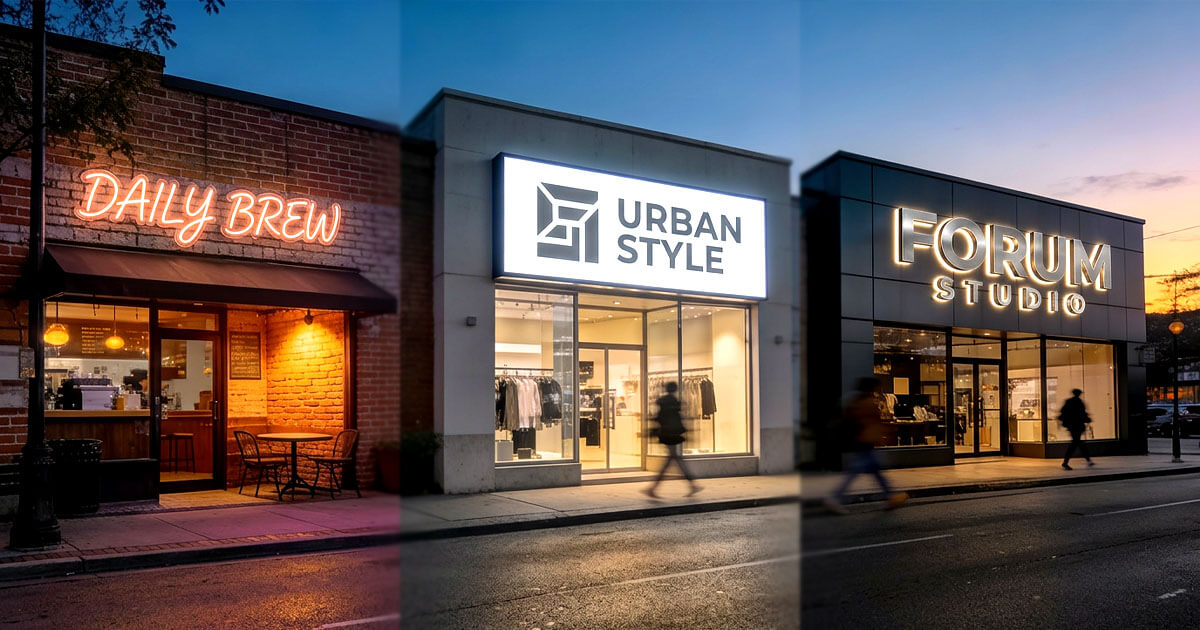
Neon sign, lightboxes, and channel letters each solve a different problem. Neon sign builds atmosphere and personality (think coffee shops, salons, Instagram-worthy storefronts). Lightboxes deliver clean, graphic-forward visibility at the friendliest price point. Channel letters project a professional presence that is readable from hundreds of feet away.
The "best" sign depends entirely on what you need it to do: pull foot traffic from a busy sidewalk, brand your storefront from a highway, or create the kind of interior vibe that makes customers linger and spend.
This guide compares all three options by cost, construction, energy use, visibility, and how well they fit your industry. You'll get clear numbers and straightforward recommendations.
What Are Neon Signs, Lightboxes, and Channel Letters? Key Differences Explained
You need to understand what each sign type actually is before comparing costs or debating aesthetics.
Neon Signs

Neon signs use illuminated tubing (traditionally gas-filled glass, now mostly LED neon flex) shaped into custom text, logos, or designs. Mounted on backboards or directly to walls, they produce a distinctive, warm, continuous glow. Most modern business neon runs on LED technology housed in flexible silicone or PVC tubing, powered by a safe 12V or 24V DC supply. Their real strength is personality: neon creates a mood that flat-panel signs can't match.
Lightbox Signs

Lightbox signs are enclosed, backlit panels where LED strips illuminate a translucent face from behind. The face can be printed on acrylic, vinyl-wrapped fabric, or dye-sublimated fabric, and stretched into a slim aluminum frame. They're the workhorses of commercial signage, appearing in shopping plazas, transit stations, and retail storefronts alike. Swap the graphic out, and you've got a new sign without touching the hardware.
Channel Letters

Channel letters are individually fabricated three-dimensional characters mounted to a building facade. Each letter has its own aluminum body, acrylic face, and internal LED modules. You see them in restaurants, retail chains, and medical offices, basically any business that needs a professional, permanent street presence. The 3D construction creates natural shadows that keep them readable even in the dark.
Here's a quick side-by-side to frame the comparison:
| Feature | Neon Signs (LED) | Lightbox Signs | Channel Letters |
|---|---|---|---|
| Construction | LED flex tubing on backing | Aluminum frame + lit panel | Individual 3D aluminum letters |
| Best for | Atmosphere, branding, interiors | Graphics, promotions, multi-tenant | Street-facing identification |
| Typical Placement | Interior walls, windows, and storefronts | Fascia, freestanding, indoor walls | Building exterior, above the entrance |
| Daytime Visibility | Low (glow washes out in sunlight) | Moderate (readable, not bold) | High (3D shadow effect) |
| Night Visibility | High (warm, eye-catching glow) | High (even backlighting) | High (illuminated letters) |
| Customization | Very high (any shape, color, script) | Moderate (graphic-dependent) | Moderate (font, color, lit style) |
| Price Range | $800–$3,000 (LED) | $1,500–$5,000 | $3,500–$8,000 |
Each sign type occupies its own lane. The real question isn't which is "best" overall; it's which one (or which combination) matches your storefront, your brand, and your budget.
How Neon Signs, Lightboxes, and Channel Letters Are Made: Materials, Lighting, and Build Quality
Understanding what goes into each sign helps you spot quality differences before you spend a dollar.
Neon sign construction
Traditional glass neon involves hand-bending soft lead glass or borosilicate tubes (8–25 mm diameter) over ribbon burners, then filling them with neon gas (for red-orange) or argon with mercury vapor (for blues, greens, and phosphor-activated colors). A bombardment process purges impurities before gas injection. Transformers step standard 120V AC up to 3,000–15,000 volts to ionize the gas. It's genuinely skilled artisan work. The price reflects that.

Modern LED neon flex has replaced glass in the vast majority of new commercial installations. These signs use SMD or COB LED chips inside flexible tubing made from PVC, polyurethane, or silicone. Tubing material is the single biggest quality indicator worth paying attention to. PVC is cheap but yellows within 1–2 years in direct sunlight.
Silicone resists UV degradation indefinitely, bends in three dimensions, achieves IP67/IP68 waterproofing, and handles temperature extremes from -40°C to +65°C. COB LED strips eliminate the visible "dotting" you see on budget signs, producing a seamless glow that closely mimics traditional neon.
For a deeper dive into what goes into an LED neon sign, see our guide to LED neon sign components.
Lightbox construction
A lightbox is a shallow aluminum or steel frame housing LED strips behind a translucent face panel. Face materials are typically 3/16-inch acrylic (sharp optical clarity, though it can yellow after 5–10 years of UV exposure) or polycarbonate (roughly 200 times the impact resistance of glass, better suited for vandal-prone or high-wind locations).

Frame depth determines how the light behaves. Ultra-thin edge-lit lightboxes (15–30 mm) use LED strips along the frame edges with etched acrylic light guides. Standard backlit versions (75–150 mm deep) mount LED modules on the rear panel, spaced 75–100 mm from the face to prevent visible hot spots.
The newer silicone-edge-graphic (SEG) lightboxes use dye-sublimated fabric stretched into aluminum channels for a frameless, gallery-quality look. If you've been in a Nike or Apple store recently, you've seen this format.
Worth knowing: fluorescent lightboxes using T8 or T12 tubes are still out there, but they're being phased out quickly. LED retrofits cut energy use by 50–71% while lasting over three times longer.
Channel letter fabrication
Channel letters are CNC-cut from aluminum sheet (typically .063-inch, alloy 5052 for the backs and .040–.063-inch for the bent returns that form the letter sidewalls). Returns run 3–5 inches deep. Translucent acrylic faces (3/16 inch) snap into extruded trim caps that hold everything together.

Four illumination styles serve different brand needs:
Front-lit letters push LED light through colored acrylic faces. Most popular, most affordable. Halo-lit (reverse-lit) letters use an opaque aluminum face with LEDs aimed backward at the wall, casting a polished backglow. Open-face letters expose the LED modules, creating a retro-industrial look. Combination front/halo-lit letters illuminate both directions for maximum visibility, at a premium cost.
LED modules from manufacturers such as SloanLED and GE Tetra have become the industry standard, with rated lifespans of 50,000–100,000 hours and warranties of up to 10 years. The most common failure point isn't the LEDs themselves; it's power supply failure, which is far cheaper to fix.
Neon Sign vs Lightbox vs Channel Letter Costs: What Businesses Can Expect
The upfront price gets all the attention, but it tells only half the story. Energy consumption, maintenance frequency, and component lifespan completely reshape the financial picture once you look at a 5-year window.
Purchase prices for a typical small-to-medium business
Traditional glass neon for a 3–to 6-foot business sign runs $3,000–$8,000 due to artisan labor and specialized materials. LED neon flex equivalents cost $800–$3,000, cutting that price by 60–75% while lasting significantly longer with almost zero maintenance.
LED lightboxes in the common 3×6-4×8-foot range cost $1,500–$5,000 for single-sided models. Double-sided units add 60–100% to the price, making lightboxes the most affordable illuminated option for businesses needing large-format visibility.
Channel letter sets of 8–12 front-lit LED letters typically run $3,500–$8,000, with halo-lit styles commanding a 15–30% premium. Per-letter pricing averages about $100 per 12-inch letter with LEDs, though complex fonts and custom logos cost more.
Installation and permits
LED neon flex often needs only basic mounting hardware ($200–$800 installed). Lightboxes run $300–$1,500 for wall mounting. Channel letters demand the most: $800–$3,000, including licensed electrician work, raceway mounting, and structural considerations.
All illuminated business signs require electrical permits ($50–$500) and sign permits ($100–$1,500, depending on your municipality). Installations above 15 feet typically add a boom lift rental at $250–$800/day.
Our neon sign installation guide walks you through every mounting method step by step.
The 5-year total cost of ownership
This is the table that actually matters for your budget:
| Cost Category | LED Neon Signs | LED Lightbox (4×6 ft) | LED Channel Letters | Traditional Glass Neon |
|---|---|---|---|---|
| Purchase | $800–$3,000 | $1,500–$5,000 | $3,500–$8,000 | $3,000–$8,000 |
| Installation + Permits | $400–$1,300 | $600–$2,500 | $1,100–$4,500 | $800–$3,000 |
| Energy (5 Years) | $425–$650 | $500–$1,000 | $550–$750 | $1,000–$1,750 |
| Maintenance (5 Years) | $100–$500 | $300–$1,000 | $375–$1,000 | $1,500–$4,000 |
| 5-Year TCO | $1,725–$5,450 | $3,100–$10,000 | $5,625–$14,650 | $6,300–$16,750 |
LED neon signs carry the lowest 5-year total cost of ownership across all sign types. Channel letters cost more upfront, but operating costs stay low, and durability is hard to argue with. Traditional glass neon carries the highest long-term burden; maintenance alone can exceed $500/year due to fragile tubes, transformer replacements ($100–$400 each), and the shrinking pool of technicians who still know how to work on them.
Energy Use and Maintenance: Which Business Sign Saves You More in the Long Run
Using the 2026 U.S. commercial electricity rate of approximately $0.14/kWh and assuming 10 hours of daily operation, the differences are real enough to affect your decision.
Annual energy costs compared
Traditional glass neon draws 3.5–4 watts per linear foot. A medium 4–6-foot storefront sign uses about 200W and costs roughly $102/year. LED neon flex achieves comparable brightness at just 1.2–4 watts per foot, bringing that same sign down to approximately 75W and $38/year. That's a 60–75% reduction in electricity. Over 10 years, LED neon saves $640–$1,000 in energy costs alone compared to glass neon.
LED lightboxes are the most energy-efficient option per square foot of signage area, at roughly 2.5 watts per square foot. A 4×8-foot LED lightbox draws about 80W ($41/year), while an equivalent fluorescent lightbox with T12 tubes pulls around 300W ($153/year). If you're still running fluorescent, that math makes upgrading hard to ignore.
Channel letters with quality LED modules consume 60–200W for a typical 8–12-letter set, costing $41–$128/year depending on letter size, count, and illumination style.
Quick reference: annual operating cost
| Sign Type | Typical Wattage | Annual Energy Cost | Rated Lifespan |
|---|---|---|---|
| Traditional Glass Neon | 150–200W | ~$102 | 8–15 years (transformer-dependent) |
| LED Neon Flex (Silicone) | 50–100W | ~$38–$51 | 50,000–100,000 hours (8–15 years) |
| LED Lightbox (4×8 ft) | 60–80W | ~$41 | 50,000+ hours (13+ years) |
| Fluorescent Lightbox | 200–300W | ~$102–$153 | 20,000–30,000 hours (5–8 years) |
| LED Channel Letters | 60–200W | ~$41–$128 | 50,000–100,000 hours (13–27 years) |
Maintenance realities
Quality silicone LED neon is maintenance-free for years: no gas to leak, no transformers to burn out, no glass to crack. If a section fails, you replace that segment without rebuilding the whole sign.
When you do need a cleaning schedule or troubleshooting, our LED neon sign care and maintenance guide has you covered.
Channel letter maintenance is similarly straightforward: occasional cleaning and the rare power supply swap. The LED modules themselves will outlast most lease agreements. Lightboxes need periodic graphic replacement (fading, damage) and LED driver checks, but the structure holds up well.
Traditional glass neon is the maintenance-heavy outlier. Phosphor coatings degrade over 7–10 years (colors shift and dim), transformers fail at unpredictable intervals, and any tube damage requires a specialist. That's the tradeoff for an authentic gas-discharge glow.
Another important factor to consider is heat. Traditional neon tube surfaces can reach 200–250°F in enclosed or high-output installations, creating a fire risk near flammable materials and increasing HVAC loads in conditioned spaces. LED neon flex stays barely above body temperature. If your sign will be mounted indoors, near merchandise or customers, that's worth considering.
Which Sign Type Stands Out More: Neon, Lightbox, or Channel Letters?
Visibility drives sales. The SBA estimates LED signage costs as low as $0.15 per 1,000 impressions, making illuminated signs one of the most cost-effective advertising formats available. But each sign type "stands out" in a different context.
Daytime visibility
Channel letters dominate here, and it's not close. Their three-dimensional construction creates physical shadows and depth that stay visible even with the lights off. The standard industry formula is straightforward: 1 inch of letter height equals 10 feet of best-impact readability. So 24-inch channel letters achieve optimal viewing at 240 feet and remain readable up to about 1,000 feet.
For businesses on roads where drivers move at 45 MPH, you'll want at least 20-inch letters to give them the 3 seconds needed to read your name.
Lightboxes perform decently in daylight since the graphic is always visible, but they lack the 3D contrast that channel letters provide. Neon is weakest during the day; the glow largely washes out in sunlight. That's the honest tradeoff when choosing neon as your primary exterior sign.
Nighttime presence
After dark, the script flips. Neon's saturated, warm glow is an attention magnet with a character that flat LED panels can't fully replicate. There's a reason the neon aesthetic keeps dominating social media for restaurants, bars, and experiential retail. The global LED neon market reached $1.91 billion in 2025 and is projected to hit $3.94 billion by 2035, driven significantly by social media culture and demand for "Instagrammable" spaces.
Channel letters with front or halo lighting perform well at night, too, especially halo-lit styles that cast a polished backglow against the building. Lightboxes deliver the most uniform illumination across the entire sign face, making them the strongest option for displaying detailed graphics or menus after dark.
Brand personality and perception
Your business identity should drive this decision:
Neon sign signals creativity, warmth, and personality. It reads as approachable and culture-forward. If your brand leans into food, beauty, lifestyle, or nightlife, neon carries an emotional weight that other sign types don't match.
Channel letters convey professionalism and trust. Consistent exterior branding, which channel letters deliver well, is widely associated with perceived reliability and corporate credibility. If your brand needs to project permanence and corporate identity, channel letters are the default.
Lightboxes read as practical and versatile. The strength here isn't emotional impact; it's the ability to display detailed branding (full logos, photography, gradients) in a clean, modern format.
For businesses exploring how neon sign specifically shapes brand perception and customer engagement, our guide to custom neon signs covers design considerations.
How to Choose Business Signage for Your Industry, Storefront, and Location
Different businesses need different things from their signage. Here's a practical breakdown by industry, with reasoning you can actually use.

Restaurants, bars, and cafes
The dual approach works well here. LED neon for interior atmosphere (building ambiance and encouraging social media sharing) paired with channel letters for exterior identification (capturing foot and drive-by traffic).
A custom neon sign behind the bar or above the counter gives customers something to photograph and post. Exterior channel letters ensure people can find you from the parking lot.
Quick-service or takeout spots in strip malls are a different story; a lightbox displaying your menu or logo may be the more practical exterior choice.
Hair salons and beauty businesses
Beauty businesses lean heavily into neon's aesthetic pull, and for good reason. LED neon in warm white or rose pink creates the kind of environment that beauty clients actively seek out and share online. For the exterior, halo-lit channel letters with brushed metal faces project the sophistication clients associate with premium services. Infinity mirror channel letters are also emerging as a trend in this space.
See how KD Esthetic transformed their beauty salon with a custom neon sign.
Professional offices
Law firms, medical practices, accounting firms, and financial advisors should default to halo-lit channel letters. The understated elegance fits conservative branding expectations, and clients notice. Standard neon is generally a mismatch for professional services, though warm-white LED neon in reception areas can work for more progressive firms looking to soften their interior aesthetic.
Exterior Echelon's custom neon sign shows how even professional offices use neon to create a modern, memorable first impression.
Retail boutiques
Front-lit channel letters for the primary exterior sign, supplemented by LED neon accents inside. The exterior handles identification and street-level awareness; the interior neon gives your store personality and creates a reason for customers to photograph your brand.
Gyms and fitness studios
Bold exterior channel letters for visibility (you need to be found from a distance), with motivational or branded LED neon inside the workout space. The energy of neon pairs naturally with high-intensity environments, and branded neon wall signs photograph well for member posts and marketing materials.
Our guide to neon signs for fitness studios covers the most popular styles and placement strategies for this space.
Budget-conscious businesses and multi-tenant locations
LED lightboxes are the most practical choice when budget is the primary constraint, or when you're in a strip mall or shopping center that already has a standardized sign band. They deliver solid illuminated visibility at the lowest upfront cost, and graphic panels can be swapped seasonally without replacing hardware.
Event venues and entertainment spaces
Combine neon signs for event spaces for a theatrical appeal with channel letters' long-distance readability. Neon handles the personality (marquee-style signage, photo-op installations, branded accent walls), while channel letters handle the wayfinding and exterior identification.
Common Business Signage Mistakes and Misconceptions Buyers Should Avoid
There's a lot of outdated advice floating around about business signs. Here are the most persistent ones, corrected.
"Neon signs are fragile and break easily."
This myth mostly applies to a version of neon that fewer businesses are buying. Traditional glass neon tubes go through an annealing process that minimizes stress fractures, and well-crafted glass signs can run 24 hours a day for over 10 years. The real vulnerability is during shipping and installation, not daily use.
But here's the bigger point: modern LED neon flex uses flexible silicone or PVC tubing that doesn't shatter. It's drop-resistant, weather-resistant, and far more durable than the glass it has largely replaced. If fragility is your concern, LED neon removes it entirely.
"Neon is outdated and dying."
The market data says the opposite. The global neon sign market was valued at approximately $2–2.5 billion in 2024 and is projected to grow at a 5–7.5% CAGR through 2032. LED neon technology is fueling that growth, and the neon aesthetic remains one of the strongest visual branding tools for social-media-driven businesses. Neon isn't going anywhere; it's just trading glass tubes for LED flex.
"Neon signs are expensive to run."
A medium traditional glass neon sign uses 150–200W, roughly equivalent to a couple of household bulbs, costing about $5–10/month. LED neon cuts that by 60–80%, bringing monthly operating costs down to a few dollars. Neon actually uses about 50% less energy than fluorescent lighting. This myth likely started when people confused high-voltage transformers with high power consumption. Voltage and wattage aren't the same thing.
"LED lightboxes always look cheap."
This reflects outdated memories of bulky fluorescent cabinet signs from the 1990s. Modern LED lightboxes with slim aluminum profiles, SEG fabric faces, or push-through acrylic elements rival any sign type in visual quality. What determines whether a lightbox looks cheap isn't the format; it's the build quality and graphic design. A poorly designed channel letter sign looks just as bad.
"Channel letters are only for big corporations."
The average front-lit channel letter set costs $3,500–$4,000 and gets used by businesses of every size. Dental clinics, yoga studios, churches, and local restaurants all use them. Budget-friendly "channel cloud" designs (a single outlined shape instead of individual cut letters) bring the entry point down further. Channel letters pay for themselves through visibility and brand trust, and the "only for big brands" argument doesn't hold up.
"LED neon looks exactly like real neon."
Not quite. Traditional glass neon emits 360-degree light with warm, saturated colors across dozens of hues (achieved through different gas combinations and phosphor coatings). LED neon primarily lights from the front, offers a narrower standard color range (though RGB expands this significantly), and produces a slightly more "digital" glow. The gap has narrowed dramatically with COB LED technology, but experienced eyes can still tell the difference. Both are legitimate choices: LED neon wins on price, safety, and durability; traditional glass neon wins on raw luminous character and color depth. Know what you're getting before you buy.
"Plastic channel letters face yellow quickly."
This was a real problem with older materials. Modern UV-stabilized acrylic and polycarbonate faces resist yellowing for 7–10+ years when sourced from reputable manufacturers. The issue persists only with budget signs using non-UV-stabilized plastics. Material quality is the determining factor, as it is with most things in signage.
Neon Signs vs Lightboxes vs Channel Letters: Which Business Signage Is Best?
There's no single "best" sign. But there is a best sign for your situation, and the decision is simpler than most guides make it out to be.
Choose LED neon signs if:
If your primary goal is atmosphere, brand personality, and social media presence. Neon works best for businesses where the experience is part of the product, such as restaurants, cafes, bars, salons, boutiques, gyms, and event spaces. The 5-year total cost of ownership ($1,725–$5,450) is the lowest of any illuminated sign type, and the interior branding value is hard to replicate with other formats. If you want customers to take photos with your brand in the frame, neon is the answer.
Choose lightboxes if:
If budget is your primary constraint, or you need maximum graphic flexibility. Lightboxes start around $1,500, are suited to multi-tenant locations and franchise businesses, and let you swap seasonal or promotional graphics without replacing hardware. They're also the most energy-efficient option per square foot of illuminated area. If you're in a strip mall with a standardized sign band, this is likely your default.
Choose channel letters if:
Suppose you need professional exterior identification that reads from a distance in all lighting conditions. Channel letters lead in daytime visibility, regulatory acceptance (most shopping center sign programs require them), brand trust perception, and long-term durability. The higher upfront cost ($3,500–$8,000) is offset by minimal maintenance and LED lifespans of 50,000–100,000 hours.
The strongest strategy for most businesses? Combine two types. Channel letters or a lightbox for exterior building identification, plus custom LED neon for interior personality. This gives you street-level visibility and the kind of in-store atmosphere that turns first-time visitors into regulars and social media advocates.
Before you commit, check three things: your local sign code and permit requirements, your landlord or shopping center's master sign program, and whether your location falls within a historic district or dark sky ordinance area. These regulations can narrow your options significantly before budget and aesthetics even enter the conversation.
If you're ready to explore the LED neon sign side of the equation, our custom neon sign builder lets you design, preview, and price your sign in minutes.



Share: