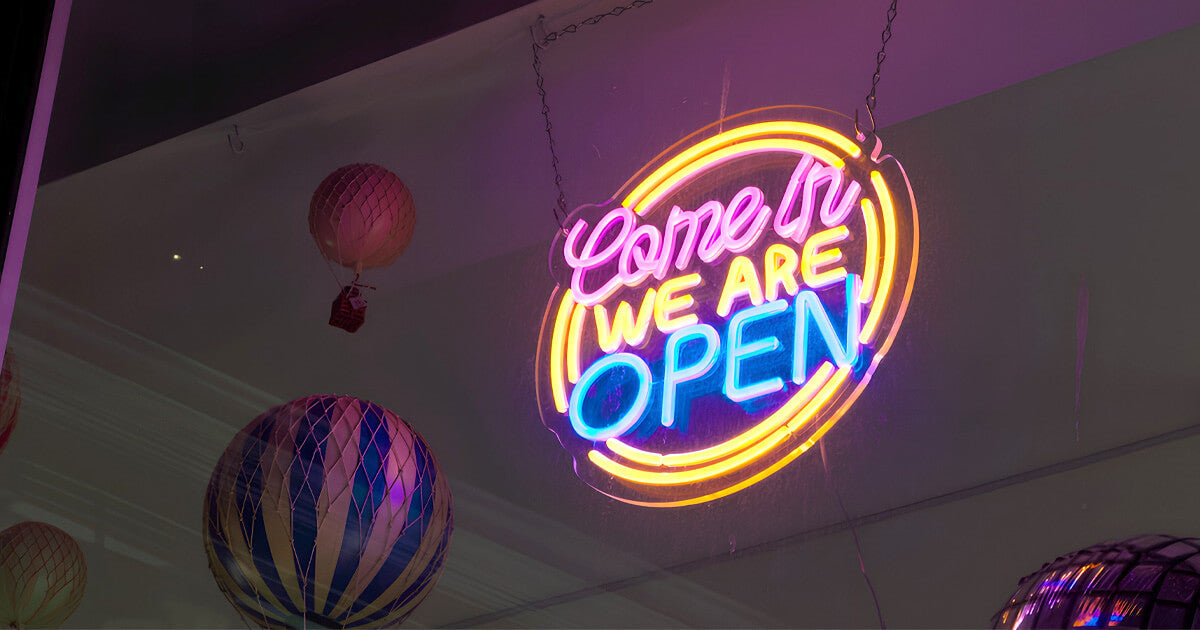

Before a customer reads your menu, checks your reviews, or even notices you on Instagram, they see your sign. A FedEx Office national survey, conducted by Ketchum Global Research & Analytics and ORC International, put a number to what most shop owners already sense: 76% of consumers have walked into a store they'd never visited before just because the sign outside stopped them. That finding has been widely cited for years. It still holds.
In 2026, this matters more than ever. Brick-and-mortar businesses are competing against phone screens for street-level attention, and the ones winning that fight know one thing: your storefront is your first impression, sometimes your only one. So when shop owners ask whether neon signs actually boost business, the evidence says yes. But the more useful question is: how much, for whom, and how fast?
That's exactly what this guide answers. By the end, you'll know whether a neon sign is right for your specific situation, which type to buy, where to place it, and what realistic results to expect.
Do Neon Signs Actually Boost Business Sales? Here's What the Data Shows
The FedEx Office survey conducted by Ketchum Global Research & Analytics and ORC International produced four findings every shop owner should know:
-
76% of consumers have entered a store they'd never visited before based solely on its signs
-
68% have purchased a product or service because a sign caught their eye
-
75% told someone else about a store based purely on its signage
-
68% believe a store's signage directly reflects the quality of its products
That last one is quietly the most powerful. Your sign isn't just drawing people in; it's setting quality expectations before anyone opens your door.
The Sign Research Foundation, working with the University of Cincinnati's Economics Center, adds hard business performance data:
-
Adding just one additional sign yields an average 4.75% increase in annual sales, a greater impact than adding more floor space, extending hours, or being longer-established at the same location
-
Roughly 60% of businesses studied reported average sales increases of 10% after signage improvements
-
Updating outdated signage produced a 5% weekly sales lift for most stores; underperforming stores saw gains of up to 15% per week.
A POPAI (Point of Purchase Advertising International) study found promotional signage increases unplanned purchases by 16%. A Nielsen study confirmed that nearly half of all shoppers first learn about in-store promotions through signage alone.
The global neon signs market hit USD 2.53 billion in 2025, growing at 5.3% annually through 2032. Customizable LED neon, the format most small businesses actually buy, is outpacing that at a 12.4% CAGR through 2033. Money doesn't flow at that scale unless results are real.
Quick reference snapshot
-
Effective signage: Any on-premise sign that is easy to read, well-lit, and on-brand, including LED neon signs and classic neon signs.
-
Impact on customers: 76% enter new stores because of signage; 68% purchase after noticing a sign; 68% judge product quality from the sign itself.
-
Impact on revenue: Studies of upgraded storefront signs show sales lifts of 10% or more after repairs or redesigns in many cases.
How Much Revenue Can a Neon Sign Really Generate for Small Shops?
Paco Underhill, founder of retail research firm Envirosell and author of Why We Buy: The Science of Shopping, put it plainly: "The store window's job is to try and present us with something intriguing enough to let the devil do his work." The sign doesn't close the sale. It opens the door. Literally.

How much is that door worth? A 2025 UK hospitality case study calculated it this way: just 5 extra walk-ins per evening, at an average spend of £22 each, equals £110 extra per night or £3,300 in additional monthly revenue. Even attributing only 20–30% of that directly to better sign visibility, the sign pays for itself within months.
A retail traffic analysis of Best Buy stores found that 17% of customers who came in hadn't planned to stop, specifically because a sign caught their attention. For a small cafe or boutique, that kind of pull adds up fast.
The ROI varies by business type. Based on data from the Sign Research Foundation, Retail Lighting Association, and hospitality industry case studies:
| Business Type | Typical Sign Cost | Expected Traffic Boost | Estimated Payback Period | ROI Tier |
|---|---|---|---|---|
| Cafe / Coffee Shop | $400–$800 | 15–20% foot traffic lift | 3–6 months | ↑ High |
| Restaurant / Bar | $500–$1,200 | 20–30% evening surge | 3–6 months | ↑ Very High |
| Hair & Beauty Salon | $600–$1,200 | 20–30% appointment increase | 6–12 months | ↑ High |
| Boutique Retail | $500–$1,000 | 15–25% walk-in increase | 4–8 months | ↑ High |
| Fitness Studio | $700–$1,500 | 10–15% new inquiry boost | 8–14 months | → Moderate |
| Professional Services | $400–$900 | 5–10% awareness increase | 12–18 months | ↓ Lower |
One thing most buyers overlook: LED neon signs consume up to 90% less energy than traditional glass neon. Annual running costs average $15–$25. Your sign works 24/7 for years with almost no recurring costs after that.
The Psychology Behind Why Neon Signs Attract More Customers
The brain makes this decision before the customer does.
The limbic system, which governs emotional memory and mood, responds to visual stimuli almost instantaneously. Before a customer consciously reads a word on your sign, their brain has already formed an emotional response to its color, brightness, and contrast.
Research published in Color Research & Application found that up to 90% of a person's initial impression of a business comes from color alone.

Here's how the psychological chain actually plays out:
1. Attention Capture. The human eye is hardwired to detect light contrast. A glowing neon sign creates an immediate visual contrast that cuts through clutter, especially in busy urban areas where everything competes for attention. Neuromarketing studies using eye-tracking confirm that illuminated signage draws fixation faster and holds it longer than static printed signage.
2. Emotional Association by Color. Different neon colors trigger measurably different emotional responses:
-
Red - stimulates energy, appetite, and urgency; ideal for restaurants and retail
-
Yellow/Amber - radiates warmth and optimism; works well for cafes and creative studios.
-
Blue - signals trust, calm, and professionalism; fits wellness and service businesses.
-
Green - conveys freshness and sustainability; great for health-focused brands.
-
Purple - carries a luxury feel with a creative edge; works well for salons and boutiques.
-
Pink/Rose - playful and inviting; powerful for beauty retail and gift shops.
3. Decision Trigger. Consumer behavior research shows that up to 85% of shoppers make purchase decisions influenced by color. A warm amber glow reading "Fresh Daily" outside a sandwich shop does more than inform. It creates appetite and emotional comfort before anyone crosses the threshold.
4. Memory Encoding. Neon signs stand out amid flat storefronts; distinctiveness sticks. Brand recognition research from Loyola University Maryland shows that 80% of consumers associate a brand with its dominant color. The Sign Research Foundation found that 79% recalled a business solely from its signage; free brand awareness, every time someone walks past.
As Philip Kotler, widely regarded as the father of modern marketing, wrote: "The art of marketing is largely the art of brand building. When something is not a brand, it will probably be viewed as a commodity." A neon sign is one of the most cost-accessible ways a small business can break out of that category.
Which Businesses Benefit Most from Neon Signs in 2026?
The businesses that see the strongest return share a common thread: revenue depends on visual brand identity, foot traffic, and impulse visits.
The rise of "Instagrammable" environments has added a multiplier effect. A neon sign brings in walk-ins. It also generates organic social content. Customers photograph it, tag your business, and share it with their followers, all without a cent of ad spend.

| Business Type | Benefit Level | Primary Use Case | Why It Works |
|---|---|---|---|
| Restaurants & Bars | ★★★★★ Very High |
Storefront draw + evening ambiance | Impulse-driven; neon thrives in low-light hours |
| Cafes & Coffee Shops | ★★★★★ Very High |
Instagram wall + window display | Atmosphere-centric; strong social sharing culture |
| Hair & Beauty Salons | ★★★★☆ High |
Brand personality + selfie spot | Client photo sharing builds organic word-of-mouth |
| Boutique Retail | ★★★★☆ High |
Window display + in-store branding | Walk-in impulse traffic; strong brand differentiation |
| Fitness Studios | ★★★☆☆ Moderate |
Motivational signage + storefront | Loyalty model limits impulse conversion |
| Professional Services | ★★☆☆☆ Lower |
Lobby branding + awareness | Referral-driven; low foot-traffic dependency |
| Pop-up / Event Retail | ★★★★☆ High |
Event presence + photo opportunities | Temporary but high-density brand exposure |
Real-world example from one of our customers: Zeus Flamed Burgers, a burger joint owned by Michael in Little Neck, NY, shared this after installing its first LED neon sign:
"I opened this business four months ago, but things really started to pop once I put up the neon sign that anyone driving by could see. Thousands of people pass this road every day, and they notice it, especially at night. It's helped boost my profits and honestly put me on the map."
A busy road. A visible sign. A business that went from invisible to discovered, with no ad budget required.
Glass Neon vs. LED Neon Signs: The 2026 Business Case
Traditional glass neon signs have real aesthetic charm, but when you run a business, charm has to justify its costs. In 2026, the case for LED neon signs over glass is overwhelming on nearly every practical axis.

| Feature | LED Neon Signs | Traditional Glass Neon |
|---|---|---|
| Upfront Cost | $200–$1,500 | $500–$5,000+ |
| Lifespan | Up to 100,000 hours (11+ years) | ~10,000 hours (1–2 years) |
| Energy Use | 1,800W; up to 80% more efficient | 4,800W; significantly higher bills |
| Operating Voltage | Safe 24V low voltage | High 3KV–18KV |
| Safety | Cool to touch, shatter-resistant | Hot glass, fragile, toxic gas risk |
| Maintenance | Nearly none, occasional dusting | Monthly professional servicing required |
| Installation | DIY-friendly, lightweight | Electrician required |
| Customization | 24+ colors, dimmable, programmable, AI design tools | Limited by gas; hand-bending required |
| Outdoor Durability | IP66-rated options, UV-protected | Vulnerable to weather and vibration |
| Sound | Completely silent | Audible buzzing |
| Instagram Appeal | Modern, clean, vibrant | Vintage, artisanal, nostalgic |
Verdict for 2026: LED neon sign wins for any business prioritizing safety, longevity, cost efficiency, and design flexibility. Glass neon retains real appeal for one specific scenario: when your brand identity genuinely calls for that mid-century, hand-crafted look, think vintage cocktail bars or retro diners where the hum and flicker are part of the atmosphere. For everyone else, LED is simply the smarter investment.
Neon Sign Placement Strategy: A Step-by-Step Guide for Shop Owners
You could have the most striking neon sign ever made and still waste its potential with bad placement. Where and how you position your neon sign matters as much as the sign itself.

Paco Underhill of Envirosell puts the window challenge plainly: "For a window, I want something that can be absorbed in two seconds. If it's longer, I have to place it somewhere a person feels comfortable enough to stand there for a prolonged amount of time to understand it."
Step 1 - Apply the 10-Second Rule
A pedestrian has roughly 10 seconds of visual contact with your storefront as they walk by. Your sign needs to communicate in under 3. Keep the message short: your name, a single benefit line, or one emotion-triggering phrase. "Fresh Daily." "Open Late." "Coffee & Calm." That's all you need.
Step 2 - Set the Right Height
For pedestrian traffic, mount your sign at 6 to 7 feet from the ground, slightly above eye level. This naturally draws the gaze upward without effort. For signs targeting drivers or high-speed foot traffic, go higher and larger, with even simpler text.
Step 3 - Prioritize Window Placement
A window-mounted neon sign does double work: visible from outside during the day against a darker interior, and magnetic at night. Suspension-hung signs with clear wire create a floating effect that catches attention from both directions of foot traffic.
Step 4 - Clear the Sightlines
Furniture, shelving, awnings, parked vehicles, anything blocking the view kills effectiveness. Before finalizing placement, stand across the street and walk the pedestrian sightlines from both directions.
Step 5 - Maximize Daytime Visibility
LED neon performs well in daylight when placed against a dark interior background. Choose high-contrast color combinations, warm amber against dark walls or white against black, to maintain visibility from noon to midnight.
Step 6 - Use Directional Signage for Off-Path Locations
If your shop isn't directly on a main street, add a secondary arrow sign from a nearby high-traffic point. A small "This Way →" neon pointer can pull foot traffic down a side street or into a courtyard.
Step 7 - Create a Social Media Focal Point Inside
Don't limit neon to your exterior. A well-designed interior sign, whether behind your counter or on a feature wall, becomes a photo magnet. Customers post it, tag your business, and extend your reach for free.
What Most Business Owners Get Wrong About Neon Signs
Five objections come up constantly. None of them holds.

Myth 1: "Neon signs are only for bars and nightclubs."
Cafes, salons, boutiques, fitness studios, florists, bookshops, and even corporate offices are among the fastest-growing adopters. Customizable LED neon is driving a 12.4% CAGR across the hospitality, retail, and events sectors. A children's bookshop with a warm "Once Upon a Time" neon is just as powerful as a cocktail lounge.
Myth 2: "They're too expensive to run."
LED neon consumes up to 90% less energy than glass neon. Running a medium-sized LED sign typically costs $15–$25 annually in electricity. Compare that cost-per-impression to any digital ad platform, and it's not close.
Myth 3: "They look cheap or tacky."
That's a design choice, not a technology limitation. Modern LED neon uses premium silicone or acrylic tubing, available in 24+ colors with dimming control and precision typography. Custom designs can be minimalist, gallery-worthy, or boldly commercial. The aesthetic is whatever you make it.
Myth 4: "Only big brands use them effectively."
The SME sector is where neon growth is happening. Small-business adoption of custom signage as a brand-differentiation strategy is explicitly cited as a key market driver through 2033. Many manufacturers offer flexible pricing suited to small-business budgets.
Myth 5: "They don't work during daylight hours."
LED neon is bright enough for daylight visibility when placed correctly, particularly against a darker interior background or in contrast with surrounding materials. High-brightness LED units in 2026 are built for around-the-clock visibility.
What to Look for When Buying a Business Neon Sign
Before you order, run through this checklist. These are the specs that separate a sign that performs from one that looks good on a product page and disappoints in the window.

-
Size to storefront ratio. Size the sign to fill roughly 40–60% of your visible window or wall space. Too small and it vanishes in the streetscape. Too large, and it overwhelms your identity test visibility by standing across the street before committing.
-
Color matched to your business personality. Warm tones (red, amber, yellow) stimulate appetite and welcoming, making them best for food, hospitality, and retail—cool tones (blue, green) signal calm and trust, better for wellness and professional services. Purple and pink suggest luxury and creativity, making them strong choices for salons and boutiques.
-
IP66/IP67 rating for outdoor signs. Any neon sign placed outdoors or in weather-exposed positions must carry an IP66 weatherproofing certification, be fully dustproof, and be protected against powerful water jets. Don't skip this spec.
-
Material quality. Look for UV-protected, flame-retardant silicone or premium acrylic tubing. Avoid cheap PVC that yellows, cracks, or fades within a year.
-
Minimum 24-month warranty. A credible manufacturer stands behind their product with at least a 2-year warranty covering LED failure, power supply issues, and premature dimming. No warranty, no purchase.
-
Dimmable brightness or an RGB remote. This gives you control over mood and visibility at different times of day.
-
DIY vs. professional installation. Most LED neon signs are light enough to install yourself, similar to hanging wall art. If your sign is large, outdoor-mounted, or requires electrical work, factor professional installation into your budget.
If you know what you need and want to see it built for your space, we can help you build your custom LED neon signs, IP66/IP67 rated for outdoor use, fully customizable, and backed by a 2-year warranty.
Bottom Line: Are Neon Signs Worth It for Your Shop or Cafe?
For foot-traffic-dependent businesses, cafes, restaurants, salons, boutiques, and bars, the evidence is consistent and compelling.

The Sign Research Foundation estimates the average sales bump from a single new sign at 4.75%. The FedEx study shows 76% of shoppers enter stores because of signage. A burger joint owner in Little Neck, NY, told us his business only really started moving once the neon sign went up.
Thousands of people pass that road daily, the sign pulls them in, especially at night, and he credits it directly with boosting his profits and putting his business on the map. Over in the UK, a bar calculated that its sign would pay for itself within months, based on just five extra walk-ins per evening.
Here's what the data tells you:
-
A neon sign is a 24/7 salesperson with almost zero recurring costs after the initial investment
-
LED neon signs in 2026 are safer, longer-lasting, and far more affordable than traditional glass ones.
-
Payback is fast; most cafes and retail shops recover costs within 3–8 months
-
Placement and design matter as much as the sign itself; the right sign in the wrong spot underperforms
-
Not every business benefits equally; high foot-traffic, impulse-driven businesses win most, referral-only or fully digital businesses win least.
Neon sign won't save a business with the wrong location, a product people don't want, or no foot traffic to speak of. Paco Underhill said it well: "Make sure to match the sign to the opportunity to the need." A sign amplifies what's already working; it doesn't replace the fundamentals.
But if you have a street-facing location, a solid product, and customers walking by? A well-placed neon sign might be the most cost-effective marketing investment you make this year.
The question isn't whether neon signs work. The question is: how much longer can you afford to let your storefront stay silent?



Share: