
Your child's bedroom should be their favorite place in the house. It's where they build pillow forts, read before bed, and daydream about anything and everything. Eventually, you'll want to give that space an upgrade that goes beyond just fairy lights and glow-in-the-dark stickers.
That's where LED neon signs for kids' rooms make a difference. They've quickly become a favorite way to upgrade children's bedrooms in the US, UK, and Canada, not just because they look cool. Today's neon signs use LED technology, so they only need about 12 volts of power (similar to a regular night light), stay cool to the touch, and won't break if a stray ball hits them. For parents who have worked hard to childproof their homes, these features are a big plus.
This article explains what makes these neon signs safe for a kid's room, which designs are best for different ages, and how to install and care for them so they hold up through years of bedtime stories, sleepovers, and the big room makeover that comes around age 13.
What Makes LED Neon Signs Safe for Kids (and Why Glass Neon Isn't)
The old-school glass neon signs you see in diners and vintage bars? Those need between 4,000 and 15,000 volts to ionize the gas inside the tube. That's not a typo. They run hot, they're fragile, and if one breaks, you're dealing with broken glass and, in some cases, mercury vapor. No parent in their right mind would hang one above a six-year-old's bed.

LED neon signs are a completely different product. They use flexible silicone or PVC tubing wrapped around energy-efficient LED strips, mounted on a lightweight acrylic backing. The voltage ranges from 12V to 24V DC, powered by a standard adapter. That falls well within the IEC 61140 extra-low-voltage classification (under 50V AC or under 120V DC), which is the electrical safety standard designed to reduce the risk of shock. Your child's tablet charger operates at a similar voltage.
Heat is the other thing parents worry about. Traditional neon tubes can reach 200°F after a few hours of use. LED neon stays cool to the touch, even after running all day. Curious fingers won't get burned, and you won't spend your evenings worrying about it.
If your child somehow knocks the sign off the wall, the silicone tubing bends and bounces rather than shattering. You can read more about how LED neon signs work in our technical guide, but the short version: these things are built to survive a kid's bedroom.
The Best LED Neon Sign Designs by Age Group
One of the smartest things about custom neon signs is that you can match them to your child's age and personality. A sign that works for a toddler's nursery won't suit a teenager's bedroom, and vice versa.

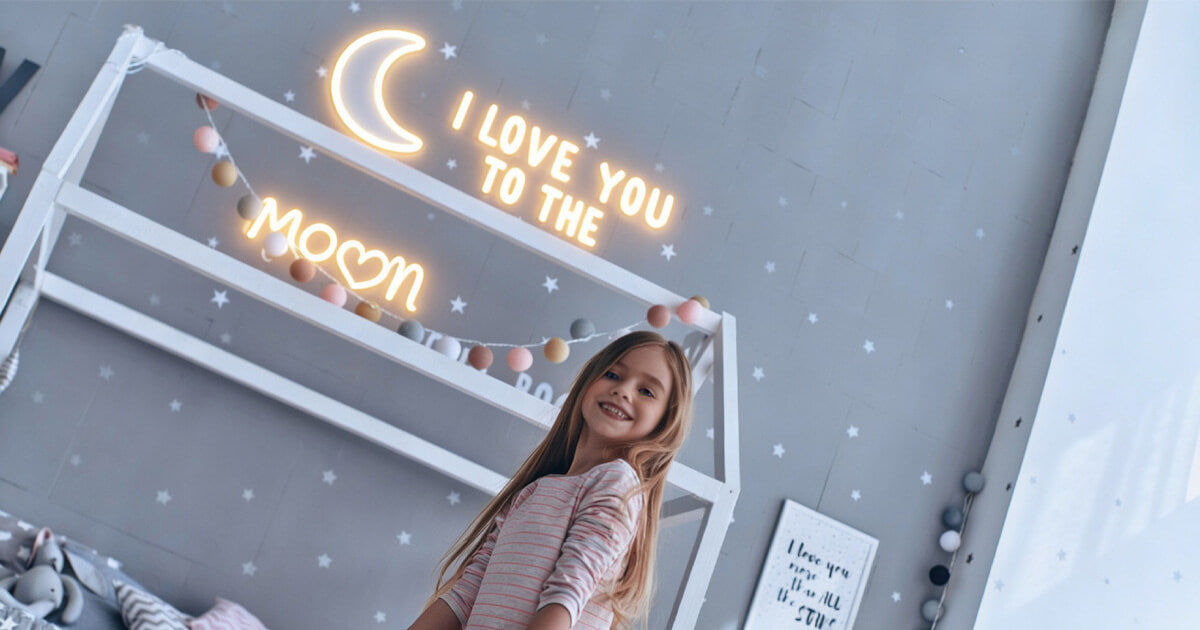
Nurseries and Toddlers (0-4 years). Simple shapes work best. Think clouds, moons, stars, or a little rainbow. Soft pastel colors (pale pink, lavender, baby blue) or warm white colors give off a calming glow that can also be used as a night light.
A lot of parents skip the dedicated night light altogether once they install a dimmable neon sign. Mount it high on the wall, out of reach, and pair it with a wireless dimmer for easy brightness control at bedtime. Our RGB remote control guide walks through how dimming works with LED neon.
Ages 5–9 are when kids' personalities really start to shine. Custom name signs, dinosaur shapes, rockets, unicorns, and sports themes have become especially popular. Kids this age want their room to feel like their own space, and having their name lit up on the wall helps make that happen. Bright primary colors and bold greens are top choices.
For kids aged 10 and up, motivational quotes, gaming designs, and music-themed neon designs are the most requested. Some favorite": "Dream Big," "Good Vibes Only," or a custom neon gamer tag.
This age group also starts caring about how their room looks on camera for video calls and social media, which makes a neon backdrop surprisingly practical. If gaming is the angle, our guide to custom neon signs for streamers has design ideas that cross over well into teen bedrooms.
Picking the Right Color (It's Not Just About Favorites)
Most parents let their kids pick a color and call it done. That's fine for a five-year-old. But if you want the sign to complement the room and serve a functional purpose, the color choice deserves more thought than "what's your favorite?"

Warm white is the safest all-rounder. It fits into just about any room style, works as ambient lighting, and doesn't over-stimulate before bed. If the main purpose of the sign is to replace a night light, then warm white or soft yellow is the way to go.
The most popular colors for girls' rooms are pink and purple, and for boys' rooms, blue and green, though many parents are moving away from these traditional colors. Red is bold and expressive but may be a little aggressive for a bedroom.
Color psychology backs this up, and our neon sign color psychology guide breaks down how different hues affect mood and attention. RGB color-changing signs are popular with older kids who want to switch things up depending on their mood, activity, or time of day.
One honest note: the cheapest LED neon signs often have uneven color distribution, where sections glow brighter than others. That's a build-quality issue, not a color issue. A well-made sign produces consistent, even light across the full design. When you're deciding, our guide to choosing the right color for your custom neon sign covers what to look for from a quality manufacturer.
How to Mount a Neon Sign in Your Kid's Room (Safely)
Mounting location matters more in a kid's room than anywhere else in the house. The general rule: install the sign at least a foot above your child's reach, even when they're standing on the bed. That keeps curious hands away from the sign, the adapter, and the power cord.

Most LED neon signs have pre-drilled holes and screw mounts, making this the safest option for a kid's room. Adhesive strips are good for lighter signs, but they can also come loose after a while, especially in warmer climates and on textured walls. Screws into wall plugs for a child's room are worth the extra 10 minutes. Our neon sign installation guide explains, step-by-step, how to mount using both methods.
Most people don't bother with cable management. It's also the most important part when there are kids around. Use adhesive cable clips or a paintable cord cover, if possible, to run the power cord along the wall and behind furniture.
The adapter needs to be placed on a shelf or mounted on the wall, never on the floor, where it becomes a toy. A cord cover channel extends from the sign to the nearest outlet, keeping all cords neat and tug-proof.
Above the headboard is the most popular placement. A desk or reading nook above a desk works well for older kids, too. Just avoid positioning the sign directly in their line of sight when lying in bed, as even a soft glow pointed at the eyes can interfere with sleep.
Can an LED Neon Sign Replace a Night Light?
Yes, and a lot of parents are doing exactly that. LED neon signs with a dimmer give you adjustable brightness, so you can run the sign at full glow during playtime and dial it down to a soft ambient light at bedtime. A standard plug-in night light can't do that.
The advantage goes beyond brightness control. A custom name sign or a moon-and-stars design becomes part of the room's decor rather than a functional afterthought plugged into the nearest outlet. Kids tend to outgrow generic night lights by age five or six. A well-chosen neon sign can stay on the wall from nursery through primary school and well beyond.
LED neon is safe to turn on overnight. They are cool-running, use very little power (a typical sign uses less electricity than a standard 60W light bulb), and have a lifespan of around 50,000 to 100,000 hours. That is roughly five and a half years of normal use. To learn more about the overnight safety and energy costs, see our guide to leaving an LED neon sign on overnight for the details.
Keeping Your Neon Sign Clean and Making It Last
LED neon signs need very little upkeep, but a kids' room is a high-traffic environment. Dust, sticky fingerprints, and the occasional splash of juice are part of the deal.
Wipe the sign with a dry microfiber cloth every few weeks. If it's a bit more sticky than that, slightly moisten the cloth with water. Do not use any chemical cleaners, glass cleaners, or anything abrasive. Harsh products can cause silicone tubing to discolor over time. Always unplug the sign before cleaning it. Our LED Neon Sign Care and Maintenance Guide Includes Seasonal Maintenance and Troubleshooting
The sign itself will last for years to come. LED strips are rated for tens of thousands of hours of use, and silicone tubing resists UV yellowing better than the cheaper PVC options. The adapter is usually the first part to wear out (about 3 to 5 years), but they are cheap and easy to replace.
What to Look for When Buying a Neon Sign for Your Kid's Room
Not every LED neon sign on the market is made with kids in mind. Here's a quick checklist before you buy:
Voltage and certification. The sign should run on 12V or 24V DC through a certified adapter. Look for UL, CE, or RoHS markings on both the adapter and the sign itself. If the listing doesn't mention voltage at all, that's a red flag.
Material. Silicone tubing is better than PVC for longevity and flexibility. It holds color better, bends without cracking, and handles temperature swings more gracefully. Ask the supplier which they use (most won't volunteer this info unless you ask). Our guide to LED neon sign components breaks down what goes into a quality sign.
Dimming capability. You want a dimmable sign for a bedroom. None of the signs has this feature. When you are adjusting brightness without getting out of bed, a wireless remote dimmer is the best choice for convenience, especially at bedtime. Our neon signs come with a remote dimmer.
Backing material. Clear acrylic gives a floating effect on the wall. Cut-to-shape acrylic follows the design's outline for a cleaner look. Both work well. Avoid signs with flimsy plastic backing that bows or flexes.
Custom vs. pre-made. Pre-made shapes (stars, clouds, hearts) are quicker and cheaper. Custom name signs or personalized designs cost more, but they do give a room a unique feel. If you're going custom, use our neon sign customizer to see fonts, colors & sizing before ordering.
A Room Upgrade That Grows With Them
Most kids' room accessories have a shelf life of about 2 years before they're swapped out for the next phase. LED neon signs tend to stick around longer because they're adaptable. A custom name sign works at three and at thirteen. A warm white moon works from the crib to the bunk bed.

The safety piece is a non-negotiable for parents, and LED Neon delivers on it without compromise, low voltage, cool to the touch, shatter-resistant, and energy-efficient enough to run all night. Add this to the ability to personalize the design, and you have a piece of decor that brings real warmth to a room, not just light.
If you're ready to design one for your child's space, send your neon design ideas through our custom design form, and we will create a free mockup so you can see the finished sign before you purchase. Choose the color, type the text, pick the size, and see it come to life on screen.






Share: