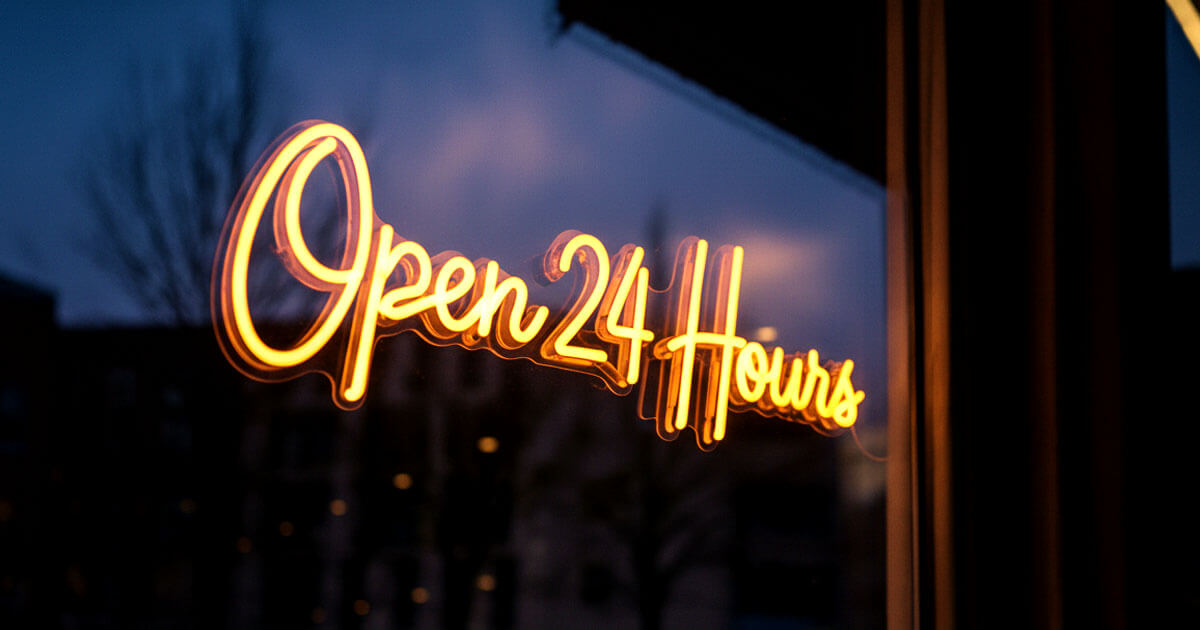

Yes, LED neon signs are generally safe to leave on overnight for both homes and businesses when they are high-quality, properly installed, certified, and kept clear of flammable materials.
These modern LED neon signs run on low-voltage systems (typically 12–24V DC), produce far less heat than older technologies, and consume relatively little electricity. That combination makes them suitable for long runtimes and even round‑the‑clock operation in many real-world setups.
For homes, overnight operation poses no significant fire risk when using a certified LED neon sign, mounting it correctly, and avoiding direct contact with fabrics or other combustibles.
For businesses and shops, LED neon signs are designed for long daily runtimes; commercial‑grade signs that are UL‑listed and installed in accordance with codes like NEC Article 600 are routinely run safely overnight in storefronts, hospitality spaces, and other venues.
Here's what you'll really take away from this guide: why LED neon flex signs behave very differently from traditional glass neon, how standards like UL 48 and NEC rules quietly protect you in the background, how overnight use affects lifespan and energy bills, and when you should absolutely switch the sign off instead of letting it glow.
You'll also get a simple checklist for safety when using a neon sign overnight, whether your sign is hanging over a bar cart at home or attracting foot traffic on a busy street.
Why LED Neon Signs Are Safe to Leave On Overnight
LED neon signs are generally safe to leave on overnight because they're low‑voltage, energy‑efficient, and engineered to produce much less heat than older lighting technologies.
Unlike incandescent bulbs, which can convert most of their energy into heat, LED sources emit relatively little heat, which dramatically reduces fire risk during long runtimes. This is one reason LED strip lights and bulbs are widely described by safety organizations as unlikely to cause fires when used properly.
That said, low voltage doesn't mean "no risk." Independent safety bodies such as Underwriters Laboratories (UL) emphasize that LED illumination sources, even at low voltage, can still generate thermal energy and must be designed so that heat isn't transferred to plastics or other combustible materials in a way that creates a fire hazard.
This is exactly what standards like UL 48 for electric signs and outline lighting are for: they lay down safety requirements so that, under normal use, including overnight operation, the sign won't overheat, shock you, or fail in a dangerous way.
LED neon flex signs differ from traditional glass neon signs in a way that matters to you overnight. LED neon flex typically runs on 12 or 24 volts DC and uses relatively low wattage per meter. Comparable glass neon installations require much higher voltage and significantly more power. Many analyses show that LED neon signs use around 70–80% less electricity than glass neon for a similar visual effect.
 Lower power draw usually means lower operating temperature, which is a big reason LED neon is favored for enclosed, residential, and 24/7 commercial used.
So, when does this "generally safe" picture break down? Mainly when one of the protections is missing: a non‑certified sign that doesn't meet relevant safety standards, an installation that ignores wiring rules like NEC Article 600, a cheap power supply that overheats, or a sign pressed up against curtains or paper displays.
When your sign is both properly certified and installed by a qualified professional, LED neon works where old glass neon might be a concern, especially in tight, modern interiors with lots of flammable finishes.
LED Neon Sign Safety Checklist Before Leaving It On Overnight
Before you leave your neon sign glowing while you sleep or while your shop is closed, run through a fast, evidence‑based safety checklist. This isn't about paranoia; it's about stacking small safeguards so you can walk away relaxed.

1. Power Supply and Certification
-
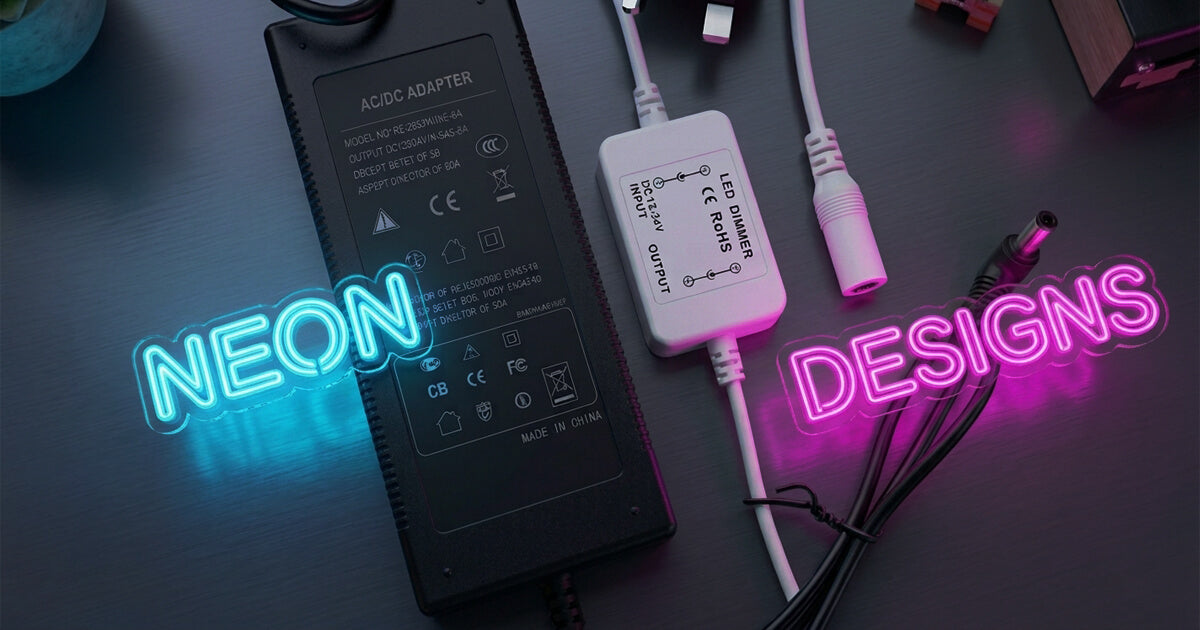
Look for recognized safety marks. Check the neon sign and its power supply for marks such as UL Listed or ETL Listed (and CE in Europe). Prefer certification on the complete power unit, not just individual components. This tells you the system has been tested for fire and shock hazards.
-
Match the voltage correctly. Confirm that the adapter's output (e.g., 12V or 24V DC) matches the LED neon sign's rated input voltage. Mismatched voltages and stress components can lead to overheating.
-
Leave some wattage headroom. Ideally, the power supply's wattage rating should be about 20% higher than your sign's actual draw. Running a transformer at its absolute limit for long hours is not good practice.
2. Inspect the Power Supply and Wiring
-
Check that the driver or transformer casing is intact, with no burn marks, warping, or cracks.
-
Ensure cables are not pinched, frayed, or crushed behind furniture. They should not hang by the plug or be under constant tension.
-
Avoid overloading power strips or daisy‑chaining multiple high‑draw devices to a single outlet.
3. Confirm Proper Mounting and Clearance
-
Mount the sign securely on a stable surface, ideally a non‑combustible surface, with an air gap behind it for ventilation.
-
Keep the sign and power supply away from curtains, bedding, paper displays, plants, or stacked cardboard. Even a relatively cool source can create a hot spot when pressed directly against flammable materials.
-
For outdoor or humid environments (bathrooms, covered patios), choose a sign and power supply with an appropriate IP rating (often IP65 or higher).
4. Look for Warning Signs
Modern LED neon signs should be almost silent, cool to the touch, and stable in brightness. Turn the neon sign off and investigate if you notice:
-
Buzzing, humming, or crackling sounds
-
Flickering or dark sections
-
Plastic discoloration or deformation
-
A burning or chemical smell
-
A power supply that feels unusually hot rather than just warm
If a sign passes this checklist, you're in a much better position to let it run overnight at home or in a shop without losing sleep over what it's doing on the wall.
Does Leaving an LED Neon Sign On Overnight Affect Lifespan or Energy Costs?
Leaving an LED neon sign on overnight does affect both lifespan and energy costs, but usually less dramatically than people assume.
 Lifespan and On/Off Cycling
Quality LED neon signs are commonly rated in the 30,000–50,000-hour range, with some premium systems marketed closer to 90,000–100,000 hours under ideal conditions. In practice, these ratings typically refer to lumen depreciation, with the neon light dimming to around 70% of its original brightness rather than failing instantly.
One important factor is on/off cycling. Every time you power up a sign, the transformer experiences a brief surge. Frequent cycling can add stress to internal components and shorten their effective life. Continuous or long-session operation, especially with a correctly sized, well‑ventilated power supply, often puts less stress on the system than rapid, repeated switching.
From a practical standpoint, if a sign rated for 50,000 hours runs 8 hours per day, it may serve you for well over a decade before noticeable dimming. Run it 16 hours per day (daytime plus late evening or overnight), and you are still talking about many years of use; you're just consuming the finite lifetime more quickly.
Energy Cost Reality
LED neon sign is one of the most energy‑efficient ways to get a neon‑style glow. Typical small‑to‑mid‑size decorative signs often use power in the tens of watts rather than hundreds.
As a rough illustration:
-
A sign drawing around 40–60 watts will consume roughly 0.04–0.06 kWh per hour.
-
At 6 hours per day, that's about 7–11 kWh per month per sign.
-
At 24 hours per day, it's still typically only a few dollars per month in many markets.
Comparisons with traditional glass neon show LED neon using a fraction of the power, commonly 60–80% less, for similar visual impact. That's why many retailers estimate that a typical LED neon sign may cost only a couple of dollars per month to run, even with heavy use, whereas an equivalent glass neon sign can cost several times as much.
So yes, overnight use slowly eats into the rated lifetime and adds to your bill, but for quality LED neon signs, those numbers are usually measured in years and modest monthly energy costs, not months and huge spikes.
The bigger risks to lifespan are poor ventilation, cheap electronics, and constant operation in hot or very humid environments.
Myths vs Facts About Leaving LED Neon Signs On Overnight
Misconceptions about neon sign safety often come from the era of traditional glass neon. Clearing them up helps you make calm, informed decisions.
Myth 1: "Any neon-style sign will overheat if you leave it on all night."
Fact: Traditional glass neon signs run at high voltage and can get noticeably warm, especially around transformers and older wiring, so they demand more caution.
LED neon flex signs, by contrast, run on low-voltage DC and are designed to minimize heat, which is why reputable brands recommend them even for children's rooms and decorative home use. The real distinction isn't "neon" vs "no neon," it's LED neon vs gas‑filled glass neon, plus build quality.
Myth 2: "LED neon signs use a lot of electricity if left on overnight."
Fact: Modern LED neon sign is one of the most efficient illuminated sign options available. Many glass neon tubes use several times as much power as their LED equivalents.
For most small decorative or branding signs, the cost of leaving an LED neon sign on for many hours a day is typically only a few units of local currency per month.
Myth 3: "If LEDs are safe, any LED neon sign is fine to leave on unattended."
Fact: Safety depends heavily on design and certification. Poorly made, non‑certified LEDs may overheat or use substandard insulation, raising fire and shock risks.
Standards like UL 48 and the UL/ETL marks you see on the label are meant to ensure the entire assembly, not just the LED strip, has been evaluated for safe operation, including heat management and wiring.
Myth 4: "Leaving an LED neon sign on overnight will destroy its lifespan."
Fact: LEDs are explicitly engineered for long, continuous use. An overnight operation consumes some of the available operating hours but does not inherently "damage" a quality sign.
The main threats to lifespan are high operating temperatures, poor ventilation, undersized or low‑quality power supplies, and harsh environments.
Myth 5: "If it's fire‑safe, it's automatically fine as a bright bedroom nightlight."
Fact: Fire safety and sleep health are different questions. From an electrical standpoint, a certified LED sign in a good installation can be safe to leave on. From a sleep standpoint, bright blue, white, or cool‑colored light in a bedroom can suppress melatonin and interfere with circadian rhythms.
In bedrooms, especially for children or sensitive sleepers, dimming, warmer colors, or timer‑based shutoff before actual sleep are usually better choices.
Leaving LED Neon Signs On All Night in Homes and Shops
Home and commercial environments ask different things about a sign, so it helps to think about them separately. They may use similar hardware, but the stakes and patterns are not the same.

Home Environments
In homes, LED neon is usually about ambience: a soft glow in the living or bedroom, a name sign in a nursery, or a statement piece in a home bar. For these spaces, the main questions are: "Is this safe near kids and furnishings?" and "Will it keep everyone up at night?"
Modern LED neon signs for home use are marketed as cool to the touch and designed for low heat output, and reputable brands back that up with safety‑tested power supplies.
Combined with basic good practice, secure mounting, clearance from fabrics, correct adapters, and use of timers, they're generally safe to leave on for evening and even overnight use. The limiting factor is more often sleep hygiene than fire risk.
Bedroom considerations need extra thought. Blue and cool‑white light can interfere with melatonin and circadian rhythm.
In bedrooms and children's rooms, you may want to:
-
Choose warmer colors (amber, warm white) for evening use.
-
Dim the sign later at night.
-
Set a timer so the sign turns off before or shortly after bedtime.
-
Place the sign where it won't shine directly into the eyes while lying in bed.
Commercial and Retail Spaces
In shops, bars, salons, and restaurants, signs are part of the business infrastructure. They're often expected to run for very long hours, sometimes 12–24 hours per day.
 For businesses, continuous or extended operation can make sense because:
-
Brand visibility: Illuminated signage advertises your business even when you're closed.
-
Perceived security: A lit storefront can deter break‑ins more than a dark, shut‑down frontage.
-
Operational simplicity: Automation avoids staff forgetting to switch signs on or off.
-
Equipment behavior: Avoiding constant on/off cycling can be easier on power supplies designed for steady operation.
The real differentiator for business spaces is compliance and liability. Electric signs are often expected to be designed to standards such as UL 48 and installed in accordance with NEC Article 600 or similar codes.
Inspectors, landlords, and insurers increasingly look for UL labeling and code‑compliant wiring as a condition of approval. A UL‑listed LED neon sign installed correctly is intended to be safe for overnight operation in unattended spaces; an undocumented import wired informally is not.
So at home, you aim for comfort and basic electrical safety; in shops, you add code compliance and documentation. In both cases, LED neon flex usually provides a stronger safety margin than traditional glass neon, provided you follow the standards and manufacturers' recommendations.
When You Should Turn Your LED Neon Sign Off Instead of Leaving It On
Even with all the safety advantages of LED, there are clear situations where you should not leave a sign running unattended overnight. Knowing these moments is as important as knowing when it's safe.
 Any sign of abnormal behavior.
-
If your LED neon sign starts flickering, buzzing, showing dark sections, or emitting a burning or plastic smell, turn it off immediately and unplug it. These symptoms indicate possible driver failure, loose connections, or overheating components.
Non‑certified or visibly low‑quality hardware.
-
If you can't find any safety marks on the sign or power supply, or if the adapter feels cheaply made and runs very hot, be especially cautious. Leaving uncertified LED products on while you sleep or leaving them on for days is not wise.
Proximity to flammable materials or poor ventilation.
-
Any sign installed in a tight, unventilated cavity or pressed directly against fabric, paper, or untreated wood should not be left running unattended, regardless of technology.
Extended absences or extreme weather.
-
For vacations, long weekends, or during severe electrical storms and grid instability, many lighting specialists recommend unplugging non‑essential signs and devices. This both saves energy and protects against rare but damaging surge events.
Sleep‑sensitive or health‑sensitive environments.
-
In bedrooms, especially for children or people with sleep difficulties, bright LED neon is better switched off or dimmed to very low, warm tones before deep sleep. In rooms used for meditation, yoga, or photography, constant colored light may not be desirable.
Think of these scenarios as your red‑flag list. If any of them apply, the safest overnight option is simple: power down, address the underlying issue, or upgrade the hardware before you treat the sign as "leave‑on‑and‑forget."
Key Takeaways: Is It Safe to Leave an LED Neon Sign On Overnight?
Pulling everything together:
-
Yes, leaving a modern, certified LED neon sign on overnight is generally safe for both homes and shops, as long as it's good quality, properly installed, well‑ventilated, and kept clear of flammable materials.
-
Compared with traditional glass neon, LED neon has clear safety and cost advantages. It operates at a lower voltage, draws much less power, and produces significantly less heat. Those differences reduce fire risk and day‑to‑day operating costs during long runtimes.
-
The power supply and installation matter most. A UL/ETL‑listed sign or power supply, installed in accordance with applicable codes (such as NEC Article 600 for commercial signs), is designed and tested with a long runtime in mind. Cheap, uncertified adapters and informal wiring are the real weak links.
-
Overnight use draws from the sign's finite operating hours but does not inherently "destroy" its lifespan. The main threats are heat, poor ventilation, cycling stress on low‑quality transformers, and harsh environments.
-
In bedrooms and child spaces, treat sleep quality as a separate dimension from fire safety. Use warm colors, dimming, and timers so the sign supports ambience without disrupting circadian rhythms.

The most useful step you can take right now is straightforward: review your current sign using the safety checklist, confirm the certifications and installation quality, tidy the area around it, and add a smart plug schedule.
If you're buying a new neon sign, prioritize LED neon flex with recognized safety marks and a properly sized, reputable power supply. With those basics in place, leaving an LED neon sign on overnight becomes just another calm, well‑managed part of your lighting plan.




Share: